How AI Knowledge Management Becomes the Foundation for Enterprise AI Agents





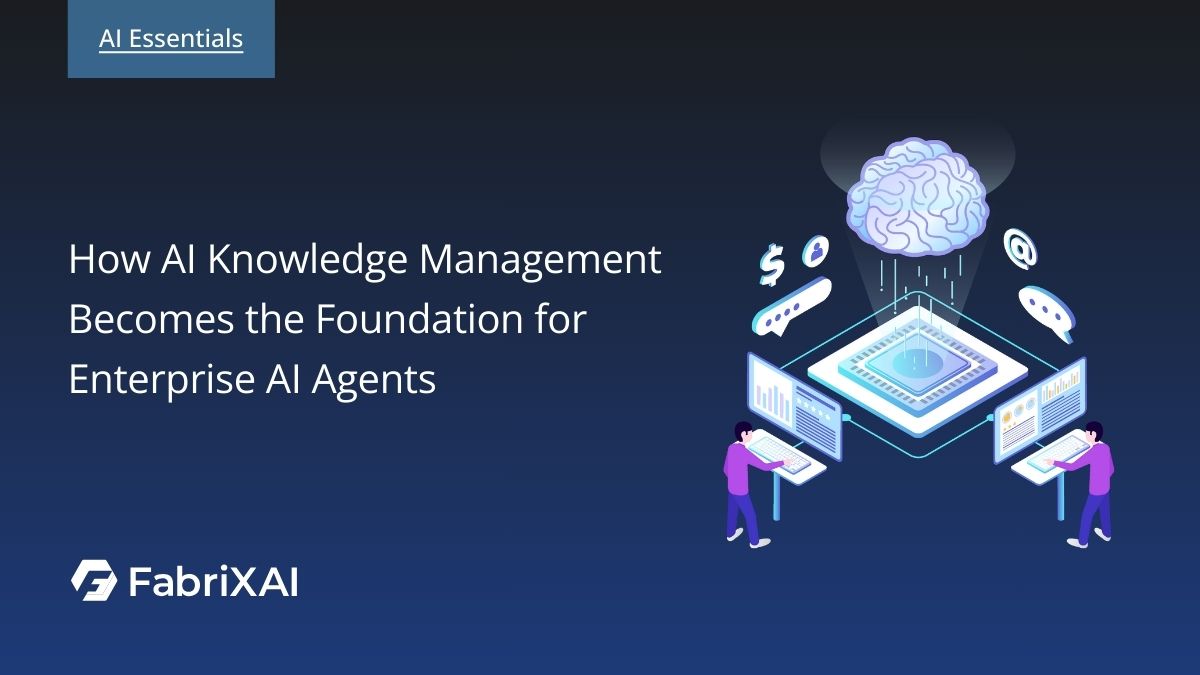
AI agents are everywhere in today’s conversations about the future of work. From autonomous copilots to self-operating workflows, the promise is compelling. Agents that act on our behalf. Agents that make decisions. Agents that scale intelligence across the enterprise.
Yet inside most organizations, the reality is far less impressive.
Early AI agents often struggle with inconsistent answers, limited understanding of context, and an inability to adapt to real organizational complexity. Instead of increasing trust, they introduce new risks. Instead of reducing effort, they create more oversight work.
The gap between hype and reality exists for one core reason.
AI agents are only as effective as the knowledge they rely on.
Without a strong foundation of AI knowledge management, agents do not create intelligence. They amplify fragmentation.
What Enterprise AI Agents Actually Need to Work
At a high level, AI agents are designed to observe, reason, and act. In enterprise environments, this requires more than access to data.
Effective agents need:
- Accurate and current knowledge
- Context across teams, systems, and time
- Clear understanding of roles, permissions, and constraints
- The ability to learn from outcomes
Most organizations underestimate how difficult this is. Enterprise knowledge is not stored in one place. It lives in documents, tickets, chat conversations, dashboards, and personal memory.
If agents cannot understand how this knowledge fits together, they cannot act responsibly or intelligently.
Why Agents Fail Without Knowledge Orchestration
Many early enterprise agents are built by connecting a language model to a few data sources. This works in controlled demos, but breaks down quickly in real environments.
Common failure patterns include:
- Agents pulling outdated or conflicting information
- Different agents giving different answers to the same question
- Actions being taken without understanding historical context
- Increased need for human review and correction
In these cases, agents are not the problem. The problem is that they operate on fragmented knowledge.
Without orchestration, AI agents inherit all the weaknesses of existing knowledge systems and amplify them at scale.
The Difference Between Automation and Intelligence
Automation focuses on execution. Intelligence focuses on understanding.
Many enterprise AI initiatives prioritize automation first. They aim to speed up tasks without addressing whether decisions are informed.
This leads to systems that act quickly but blindly.
Intelligence requires:
- Context
- Memory
- Reasoning over past experiences
- Awareness of tradeoffs and consequences
AI knowledge management provides these capabilities. It ensures that when agents act, they do so based on shared understanding rather than isolated data points.
AI Knowledge Management as the Agent Backbone
AI knowledge management creates a structured, connected view of enterprise knowledge. Instead of treating information as files or messages, it treats it as organizational understanding.
This foundation allows agents to:
- Access consistent knowledge across systems
- Understand why decisions were made
- Explain their recommendations
- Adapt as new information appears
In this model, agents are not independent actors. They are participants in the organization’s intelligence system.
This is what turns agents from experimental tools into reliable teammates.
From Human Intelligence to Agent Intelligence
Before organizations trust agents to act, they must trust them to assist humans.
AI knowledge management often starts by supporting employees:
- Helping teams learn from past incidents
- Providing context for decisions
- Reducing time spent searching for information
As trust grows, the same knowledge foundation can power agents. The key insight is that humans and agents should rely on the same intelligence layer.
This alignment ensures:
- Consistency between human and AI decisions
- Transparency in how conclusions are reached
- Faster adoption across teams
Agents become extensions of organizational intelligence rather than external systems.
Real Agent Use Cases Enabled by AI Knowledge Management
When knowledge is orchestrated, enterprise agents become practical and valuable.
Support Agents
AI agents can assist support teams by:
- Recommending accurate, context-aware responses
- Learning from past resolutions
- Escalating issues with full historical context
This improves consistency without removing human judgment.
Operations Agents
Operations agents can:
- Monitor workflows
- Flag exceptions based on historical patterns
- Recommend next steps grounded in prior outcomes
Instead of rigid automation, these agents support adaptive decision-making.
Leadership Insight Agents
For leadership teams, agents can:
- Synthesize insights across departments
- Surface emerging risks
- Answer strategic questions without manual reports
This creates clarity without increasing reporting overhead.
Why Orchestration Matters More Than Models
AI models evolve rapidly. New versions appear every few months. Organizations that tie intelligence directly to specific models risk constant rework.
Knowledge, however, is durable.
An AI Knowledge Orchestration Layer separates knowledge from models. It ensures that intelligence remains stable even as underlying AI technology changes.
This approach:
- Reduces vendor lock-in
- Improves long-term reliability
- Allows organizations to adopt new models without disrupting intelligence
In enterprise environments, orchestration matters more than model performance alone.
The Role of an AI Knowledge Orchestration Layer
An AI Knowledge Orchestration Layer sits between enterprise systems and AI applications.
Its responsibilities include:
- Connecting knowledge across tools and teams
- Maintaining context and permissions
- Ensuring consistency across AI outputs
- Enabling traceability and trust
For AI agents, this layer is essential. It provides the structure needed to act responsibly at scale.
Without it, agents remain isolated experiments.
How Organizations Can Prepare Today
Organizations do not need to deploy autonomous agents immediately to benefit from AI knowledge management.
A practical path forward includes:
- Identifying high-friction knowledge areas
- Connecting existing systems into a unified view
- Supporting human decision-making first
- Gradually extending intelligence to agents
This approach reduces risk while building a strong foundation.
Turning Enterprise Knowledge into Agent-Ready Intelligence with FabriXAI
As interest in AI agents grows, the need for orchestration becomes unavoidable.
FabriXAI is built as an AI Knowledge Orchestration Layer that connects enterprise systems, understands knowledge in context, and makes organizational intelligence accessible to both humans and AI agents.
Rather than focusing on individual models or tools, FabriXAI focuses on creating a durable intelligence foundation that agents can rely on as they evolve.
If you are exploring AI agents and want to ensure they are grounded in trusted enterprise knowledge, contact us to start the conversation.
Conclusion: Smarter Agents Start with Smarter Knowledge
AI agents will play a significant role in the future of enterprise work. But their success depends on what they know and how they understand it.
Without AI knowledge management, agents amplify fragmentation. With it, they become powerful extensions of organizational intelligence.
The path to reliable enterprise AI does not start with autonomy. It starts with shared understanding.
AI knowledge management is not an add-on for agents. It is the foundation they require to truly work.
Frequently Asked Questions (FAQ)
1. What is the connection between AI agents and AI knowledge management?
AI agents rely on accurate, contextual knowledge to reason and act effectively. AI knowledge management provides the structured, connected understanding that agents need to deliver reliable and trustworthy outcomes.
2. Why do enterprise AI agents often fail in real environments?
Many agents fail because they operate on fragmented or outdated knowledge. Without orchestration, agents amplify inconsistencies rather than creating intelligence, leading to trust and reliability issues.
3. Can AI knowledge management be used without deploying AI agents?
Yes. Many organizations start by using AI knowledge management to support human decision-making and learning. Agents can be added later using the same knowledge foundation.
4. How does an AI Knowledge Orchestration Layer help AI agents?
An orchestration layer connects knowledge across systems, enforces context and permissions, and ensures consistency. This allows AI agents to act based on shared organizational understanding rather than isolated data.
5. Are AI agents dependent on specific AI models?
No. When knowledge is orchestrated independently of models, agents can evolve alongside new AI technologies without disrupting enterprise intelligence or requiring major rework.
Related Posts

Beyond the AI Experiment: Join FabriXAI to Explore Agentic AI in Action
AI Is Not a Source of Truth: How to Use AI Without Overtrusting It